MAXUS V80 Body Parts: Serving Commercial Van Fleets
If you operate a fleet of light commercial vehicles anywhere from Lagos to La Paz, there is a good chance at least one of your vans is a MAXUS V80. Since SAIC Motor relaunched the LDV / MAXUS badge in 2011 and put the V80 into mass production, the model has become one of the most-exported Chinese commercial vans on the planet. In markets as diverse as Australia, the United Kingdom, Chile, Malaysia, South Africa, the Philippines, and Ireland, the V80 has carved out a quiet but very loyal following among courier operators, shuttle services, hotel shuttle fleets, ambulance services, refrigerated-goods hauliers, and small-business owners who need a reliable workhorse that can be repaired in any provincial capital. That popularity creates a steady, year-round demand for MAXUS body parts — front bumpers, rear bumpers, side panels, grilles, mirror assemblies, headlights, tail lamps, and the structural reinforcements behind them. For a wholesale distributor or a fleet workshop owner, understanding the V80 body parts catalogue is the difference between a van that is back on the road in 48 hours and one that sits on the ramp for three weeks waiting for a single pressed panel from the other side of the world.
This guide is written for fleet operators, body shops, and parts distributors who already know the V80 and want to source MAXUS body parts more intelligently. It covers the body panels that fail most often, the model-year variations that catch even experienced buyers out, the export-market considerations that affect fitment, and how a trusted body parts supplier with deep stock can keep your fleet moving without paying for emergency air-freight on every replacement.
Why the MAXUS V80 Has Become the Default Commercial Van for Export Markets
To understand the demand for MAXUS V80 parts, it helps to understand the vehicle itself. The V80 was developed as a high-roof, long-wheelbase, front-wheel-drive panel van with a payload capacity between 1,000 and 1,400 kilograms depending on the variant. It is offered in wheelbase lengths of 3,100 mm, 3,850 mm, and 4,000 mm, with roof heights of standard and high, and with both passenger (9-seat and 14-seat) and cargo body configurations. The drivetrain options include a 2.5-litre turbodiesel, a 2.5-litre naturally aspirated diesel, and — more importantly — a fully electric eV80 that is now common in European and Australian city-fleet applications.
That breadth of variants, combined with a price point typically 20 to 35 percent below comparable European and Japanese competitors, is the reason the V80 is so widely adopted as a fleet vehicle. A small courier company in Manila can buy a brand-new V80 for the same money as a five-year-old used Toyota HiAce, and the brand-new vehicle comes with a factory warranty, predictable parts availability, and a body parts catalogue that is fully documented. For fleet operators, the math is compelling.
It is also the reason that the aftermarket for MAXUS V80 body parts has matured so quickly. Where early V80 owners had to wait weeks for body panels to arrive from China, a well-stocked body parts supplier today can ship a replacement front bumper, rear bumper, or mirror assembly to most export ports in 12 to 18 days by sea, or in 4 to 6 days by air for urgent orders. The supply chain has caught up with the demand.
The MAXUS V80 Body Parts Catalogue at a Glance
The V80 body parts catalogue is not as deep as that of a long-established European van like the Transit or the Sprinter, but it is far deeper than most buyers expect. The four categories that account for roughly 80% of wholesale demand are front and rear bumpers, grilles and grille surrounds, mirror assemblies, and side / rear body panels. Each has its own failure pattern, its own model-year variants, and its own pricing dynamics.
Front and Rear Bumpers
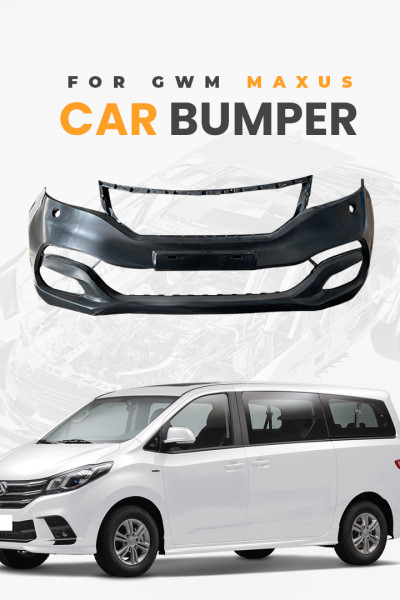
The V80 front bumper is the single highest-turnover body part on the platform. It is a three-piece design on most variants — a main face, a lower air-dam / skid-plate section, and a pair of side end caps that wrap around to the wheel arch. Most low-speed urban collisions only damage the main face and the lower section, which means workshops can often replace just those two pieces without disturbing the end caps. Rear bumpers follow a similar three-piece logic. The main face carries the reflectors, the licence plate lamp, and on some variants the rear fog lamp cut-out. A typical MAXUS bumper replacement job at a fleet workshop takes 90 minutes for the front and 60 minutes for the rear once the part is on the bench.
If you are buying wholesale, it is worth noting that the V80 front bumper has gone through three distinct visual revisions. The pre-2014 V80 had a horizontally slatted grille with squared headlamp surrounds. The 2014 to 2018 facelift introduced a wider, more upright grille with a taller bonnet line. The 2019 and later "V80 Plus" update added a sleeker, more aerodynamic front end with integrated LED daytime running lights and a redesigned bumper that is not interchangeable with the earlier versions. Make sure you know which version you need before you place an order.
Grilles and Grille Surrounds
The V80 grille is a smaller-volume item than the bumper, but it carries a higher unit margin and is a frequent casualty of frontal impacts that leave the bumper intact. There are two grille SKUs in steady demand: the upper main grille (the slatted section behind the MAXUS badge), and the lower air intake grille (the mesh section in the bumper face). Both are typically replaced together because a damaged lower grille usually means the upper grille has been pushed back into the slam panel.
Mirror Assemblies
V80 mirror assemblies are the highest-volume electrical body component on the platform. The V80 uses a large, two-piece mirror housing — a main mirror glass with electric adjustment and heating, and an integrated wide-angle lower spot mirror for kerb-side visibility in tight urban streets. Side mirrors on commercial vans are damaged far more often than on passenger cars because the vans spend their working lives in narrow streets and congested loading bays. A single mirror assembly takes about 30 minutes to swap out, and most fleet workshops keep two or three in stock at all times.
Side and Rear Body Panels
The side panels — sliding-door skins, rear quarter panels, and the large flat load-area walls — are the lowest-turnover but highest-value body parts in the catalogue. A new full sliding-door skin, for example, can retail for three to four times the price of a front bumper. These panels are rarely damaged in low-speed urban use, but when they are, the van is usually off the road until the replacement arrives. For fleet operators, keeping at least one of each major side panel in stock is a defensive decision — it costs a little in working capital, but it prevents the worst-case scenario of a van sitting idle for weeks.
The OOZOM mobile app gives fleet operators and distributors instant access to MAXUS V80 body parts pricing and stock levels across 21 Chinese automotive brands.
Model-Year Differences That Catch Out First-Time Buyers
The single most common sourcing mistake with MAXUS V80 parts is treating the model as a single SKU. It is not. Over the production life of the V80, SAIC has carried out at least four substantive updates, and each one changed the shape, mounting points, or electronics of one or more body panels. We have seen distributors order a 2016-vintage front bumper by mistake for a 2021 van, and the part was simply two centimetres too narrow at the headlamp surround. The fit was close — but close is not good enough when the customer is expecting an OE-grade replacement.
| Production period | Key body parts change | Common confusion |
|---|---|---|
| 2011–2013 (V80 Mk1) | Original wide-grille design, halogen headlamps | Confused with 2014+ facelift |
| 2014–2018 (V80 Mk1 facelift) | Upright grille, revised bumper, DRL added on higher trims | Confused with 2019+ V80 Plus |
| 2019–2023 (V80 Plus) | Sleeker front end, LED DRL, new bumper mould | Confused with V80 EV variant |
| 2024+ (V80 Plus update) | Revised radar mount, ADAS sensor cut-out | Confused with earlier V80 Plus |
The safest rule of thumb is to confirm the production year of the donor vehicle before confirming the order, and to ask your body parts supplier for photographs of the OE-number label on the back of the part. A trustworthy supplier will have that label visible on every sample. Anyone who only sends marketing images is not the actual factory.
Why Fleet Operators Switch from European to Chinese Commercial Van Parts
A decade ago, most fleet operators in emerging markets considered Chinese commercial van parts a last resort — something they accepted when the original brand was unavailable, and only then reluctantly. That perception has changed dramatically. Three forces drove the shift.
First, the OE quality gap closed. Modern injection tools, computerised paint-matching systems, and PPAP-grade quality control at the leading Chinese moulding shops now produce body parts that match the original within a millimetre on fitment and within a Delta-E of 1.0 on colour. A workshop owner who fits a MAXUS V80 front bumper today cannot tell the difference from a genuine SAIC part once it is painted.
Second, the price gap widened. A genuine SAIC V80 front bumper retails for between 320 and 480 USD in most export markets. The equivalent OE-spec aftermarket bumper is between 95 and 160 USD. That is a 60 to 75 percent saving on the part alone — and because the labour cost of fitting a bumper is the same regardless of brand, the saving flows almost entirely to the bottom line.
Third, the supply chain matured. Where European and Japanese commercial van parts typically ship from regional warehouses with 5 to 10 day dispatch windows, a Chinese body parts supplier with stock in a 50,000 square-metre central warehouse can ship a replacement within 24 to 72 hours of payment confirmation. For fleet operators, that means the difference between a 3-day repair and a 21-day repair — and the latter costs more in lost revenue than the parts price difference saves.
That combination — OE-grade quality, 60 to 75 percent lower price, and faster delivery — is the reason the V80 aftermarket has grown the way it has. It is also the reason that established European and Japanese van parts brands have begun quietly sourcing selected MAXUS panels from Chinese factories themselves.
Common Body Parts Failures on High-Mileage V80 Fleets
After a V80 passes 120,000 kilometres, three body parts tend to fail more often than any others. Knowing the failure pattern lets you stock proactively rather than reactively.
- Front bumper reinforcement beam. The steel reinforcement behind the front bumper is designed to absorb low-speed impact and protect the radiator and bonnet latch. After a decade of curb strikes and parking-lot nudges, the beam bends, the mounting brackets crack, and the bumper starts to sag at one corner. Replacing the beam costs a fraction of replacing the radiator.
- Sliding-door outer skin and handle carrier. The sliding door on the V80 is the most-used moving panel on the vehicle — it opens and closes hundreds of times per shift in a courier fleet. The outer skin develops stress cracks around the handle, and the handle carrier cracks where the lock cylinder mounts. Both are available as separate parts, so you do not have to replace the whole door.
- Wing mirror assemblies. As mentioned above, mirrors are the highest-volume electrical body part. On high-mileage fleets, expect to replace each van's mirrors three to six times over a 10-year life. Stocking two or three assemblies per van is not excessive.
For a 10-vehicle fleet, stocking one of each of these three items as a buffer costs less than 2,000 USD and prevents the most common scenarios that put a van off the road for a week.
Sourcing MAXUS V80 Parts From China: What Separates a Good Supplier From a Bad One
The growth of the V80 aftermarket has attracted both serious body parts supplier operations and opportunistic resellers who simply re-export whatever they can find on the open spot market. Telling them apart before you place a container order takes some work, but the signals are clear once you know what to look for.
- OE-number labelling. A serious supplier prints the MAXUS OE number on every carton and on every product page. A reseller without OE access cannot do that.
- Mould origin. A supplier that builds its own moulds and can name the moulding machine (e.g., 1,600-ton injection press from Haitian or Yizumi) is the actual factory. Anyone who cannot answer that question is a trader.
- PPAP documentation. For repeat business, a serious supplier will provide Production Part Approval Process records, dimensional reports, and material certificates. A trader cannot.
- Sample policy. A serious supplier will ship paid samples with full tracking and a written lead time for the production batch. A trader will quote you a sample price but never actually deliver.
- Multi-brand catalogue. V80 buyers usually also need parts for other vans in the fleet — Transit, Sprinter, HiAce, Vito. A supplier with 20-plus brand coverage can consolidate your container, which saves 30 to 40 percent on per-shipment freight.
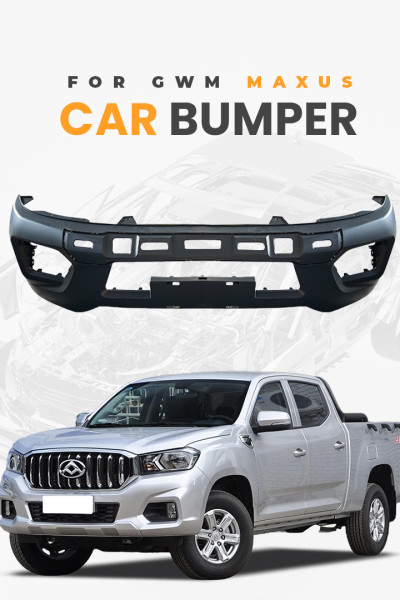
The product grid below shows four of the highest-turnover body parts currently in the OOZOM catalogue. Each links to a verified product page with OE reference, model-year coverage, and stock status — the kind of detail a serious fleet operator expects from a body parts supplier before placing a wholesale order.


How a 50,000 m² Warehouse Changes the Fleet Parts Equation
The single biggest operational advantage that a serious V80 body parts distributor has today is scale at the stocking point. Until about 2018, most Chinese exporters operated from small regional warehouses with limited SKUs. If you needed a sliding-door skin for a 2016 V80 in the middle of a busy month, you were at the back of the queue behind bigger buyers with standing orders. That has changed.
A central warehouse of 50,000 square metres — roughly the size of seven football fields — can hold between 80,000 and 120,000 SKUs at any given time, including complete bumper, grille, mirror, and panel coverage for the V80 across all model years. For a fleet operator, that means the part you need is almost certainly on the shelf rather than on the production line, which cuts the typical lead time from 21 to 45 days down to 7 to 14 days. For a distributor building a container load, it means you can mix V80 parts with 20 other body parts ranges in a single shipment and pay one freight bill instead of three or four.
The operational consequence is that fleet operators who previously maintained their own buffer stock of 30 to 60 days are now comfortable running with 7 to 14 days of buffer, because they trust the warehouse to refill quickly. That frees up working capital for the fleet itself, which is where the money actually earns its return.
Conclusion: Keep Your V80 Fleet Moving With the Right Body Parts Partner
The MAXUS V80 is no longer an emerging-market curiosity — it is the default light commercial van for thousands of fleets in more than 50 countries. Body parts demand will continue to grow as the installed base ages past the 5-year mark and as more variants (especially the electric eV80) enter service. Fleet operators and workshops that build a reliable supply relationship with a serious Chinese body parts supplier today will spend the next decade reaping the rewards — lower parts cost, faster repairs, and a more predictable cost of ownership per kilometre.
Stock MAXUS V80 Body Parts From OOZOM
OOZOM supplies wholesale MAXUS body parts — front and rear bumpers, grilles, mirror assemblies, sliding-door skins, and reinforcement beams — direct from a 50,000 m² central warehouse covering 21 Chinese automotive brands. We support MOQ 1 so you can place a single test order today, and we ship consolidated containers that mix V80 parts with your other fleet ranges to minimise per-shipment freight. Every product page lists the OE reference, the applicable model years, and current stock so you can quote your workshop without guesswork.